Music of the Natural World
Brahms Symphony No. 2
MARCH 13
7:30 PM - Wilson Center @ CFCC
Looking at Nature
Take a journey through the beauty of nature with Ryan Lindveit’s gorgeous portrait of the Smoky Mountains, Wilmington composer Barbara Gallagher’s The Flowers, (Azalea Festival, here we come!), and Brahms’ pastoral Second Symphony, written while on vacation in the idyllic Austrian Alps. Also featuring the High School and UNCW Division winners of the 2027 Richard R. Deas Concerto Competition.
Peter Askim, Conductor
Barbara Gallagher: Suite from The Flowers
High School Division Winner, 2026-27 Richard R. Deas Young Artist Competition
UNCW Division Winner, 2026-27 Richard R. Deas Young Artist Competition
Ryan Lindveit: Desire Lines
Johannes Brahms: Symphony No. 2 in D, Op. 73
COMPOSERS

Barbara Gallagher
Barbara Gallagher is a Wilmington composer whose music is performed regionally by the Florence Symphony, Raleigh Civic Symphony, Tallis Chamber Orchestra, Wilmington Symphony and Wilmington Symphony Youth Orchestra, Duke String School, Cape Fear Community College Orchestra, and Winston-Salem Civic Orchestra among others. Her spiritual/new age piano recordings are broadcast on Pandora, Accuradio, SiriusXM, and New Age Piano iOS app; she composed the theme music for WBPL's "Carolina Catholic" radio show.
Gallagher’s principal teachers at UNCSA (B.M.) were Sherwood Shaffer and Robert Ward, followed by studies with Vincent Persichetti and Mary Anthony Cox at The Juilliard School (M.M.) and additional graduate coursework in ECU's Dept of Professional and Technical Communication. GIA Inc., Hal Leonard Corporation, and musicforbrass.com publish Gallagher's music. As a hearing-impaired musician, she advocates for greater accessibility to music and speech for those with hearing loss. She teaches and plays at various churches, as well as producing the ComposerWorks concert series and collaborating on numerous projects with area artists such as Brierwood Ensemble and Forward Motion Dance Company.

Ryan Lindveit
Ryan Lindveit (lind-vite) is a composer who takes inspiration from nature, art, science, technology, and personal experience in order to craft colorful and emotionally vivid musical journeys. His catalog includes works for orchestra, wind ensemble, chamber ensembles, soloists, voice, electronics, and visual media, and Lindveit enjoys collaborating with many different types of musicians, from young students to established professionals.
His works have been commissioned and performed by several distinguished ensembles and musicians including the Minnesota Orchestra, Alarm Will Sound, Akropolis Reed Quintet, “The President’s Own” U.S. Marine Band, the U.S. Navy Concert Band, the New York Youth Symphony, Sioux City Symphony Orchestra, and the wind ensembles at dozens of universities across the country. Ryan also composed the score for the four-part, Sam Elliott-narrated docuseries Honor Guard released on Amazon Prime.
Lindveit is a recipient of the Charles Ives Scholarship from the American Academy of Arts and Letters, ASCAP Morton Gould Young Composer Award, BMI Student Composer Award and various honors from the National Band Association, Symphony in C, Tribeca New Music, and the Texas Music Educators Association, among others. His works have appeared at many festivals and conferences including the Aspen Music Festival, Santa Fe Chamber Music Festival, College Band Directors National Association Conferences (national and regional), Mizzou International Composers Festival, American Composers Orchestra Earshot New Music Readings, Next Festival of Emerging Artists, Red Note New Music Festival, the International Young Composers Meeting (Apeldoorn, NL), Singapore International Band Festival, Penn State International New Music Festival, and Sacramento State Festival of New American Music. Lindveit also won both the New Music for Orchestra and New Music for Wind Ensemble competitions at the University of Southern California.
A committed educator, he has taught composition, music theory, orchestration, film music, and music technology privately and at the collegiate level. He currently serves on the faculty of the Natalie L. Haslam College of Music at the University of Tennessee, Knoxville, where he received the 2025 Outstanding Faculty Creative/Scholarly Achievement Award. Lindveit is grateful for his music teachers in the public school system in Texas and to his mentors at the University of Southern California (BM), Yale University (MM, MMA), and the University of Michigan (DMA). Additionally, he earned the Certificate in Music Theory Pedagogy from the University of Michigan. At USC, he was selected as Salutatorian for the class of 2016 and named an Outstanding Graduate from the Thornton School of Music. His past teachers include Aaron Jay Kernis, Michael Daugherty, Frank Ticheli, Andrew Norman, Christopher Theofanidis, David Lang, Ted Hearne, Martin Bresnick, Bright Sheng, and Donald Crockett.
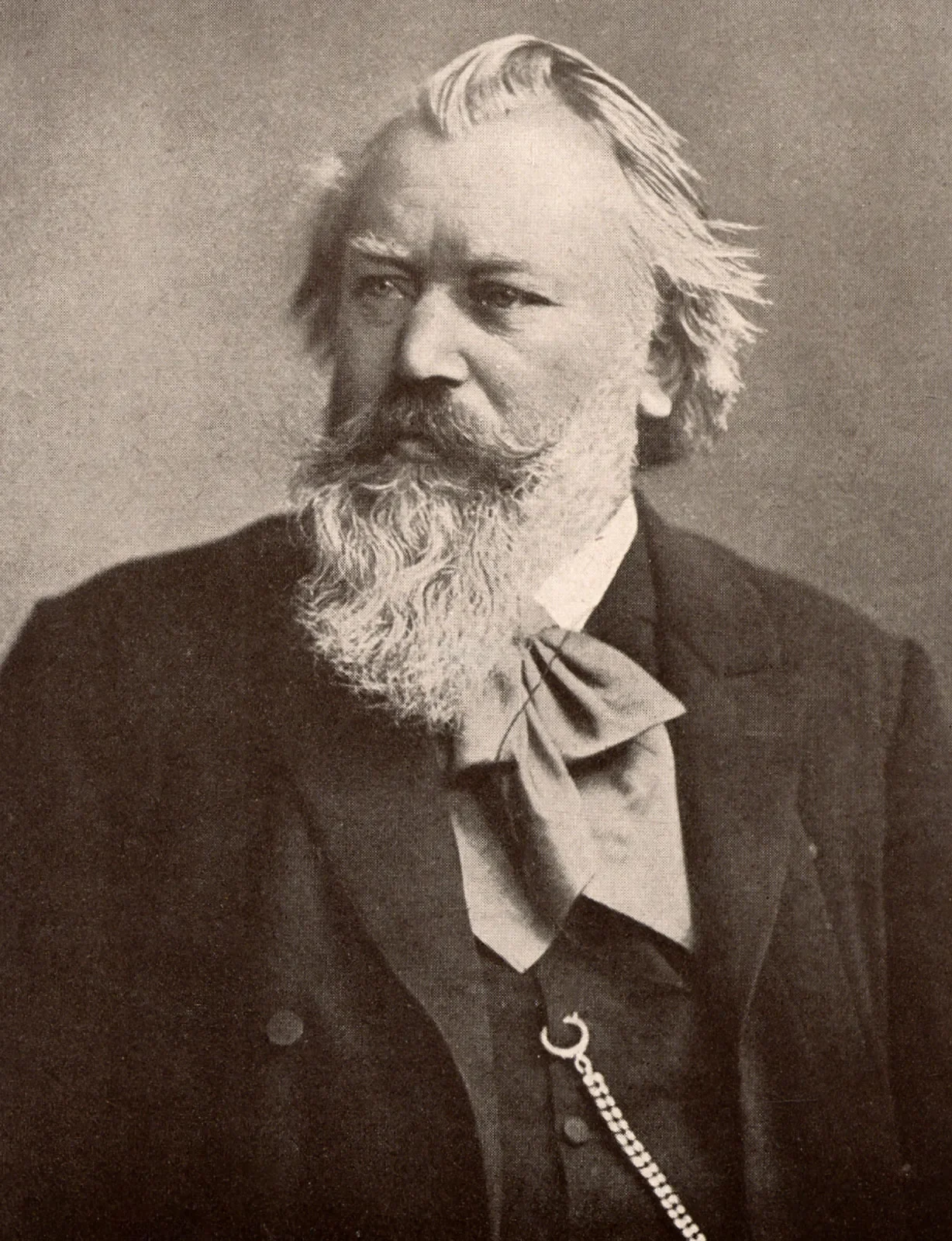
Johannes Brahms
Johannes Brahms (1833–1897) was a German composer and pianist of the Romantic era, widely regarded as one of the greatest masters of symphonic and chamber music. Though a Romantic composer, he was deeply influenced by the Classical tradition, drawing inspiration from composers such as Mozart, Haydn, and Beethoven while developing a richly expressive and structurally refined style.
Born in Hamburg, Brahms showed early musical talent as a pianist and composer. His career gained significant momentum after meeting composer Robert Schumann, who recognized his genius and helped bring him to public attention. Brahms later settled in Vienna, where he spent much of his professional life.
Brahms composed in many genres, including symphonies, concertos, chamber music, piano works, choral music, and more than 200 songs. His most notable works include four symphonies, the German Requiem, and the popular Hungarian Dances.
Celebrated for his craftsmanship, lyrical depth, and balance between tradition and innovation, Brahms remains a central figure in the classical repertoire, often grouped with Bach and Beethoven as one of the “three great B’s” of music history.
FAQ
-
The Wilson Center Box Office (wilsoncentertickets.com)and Kenan Auditorium (uncwarts.universitytickets.com)are the only official ticketing providers for Wilmington Symphony Orchestra Concerts. Tickets purchased from resellers are often inflated in price and not eligible for event cancellations, rescheduling, or other changes. Buying directly from the Wilson Center is the only way to guarantee real tickets at the best price.
-
Clapping is encouraged! Just not all the time or while the musicians are playing… It is customary to hold your applause until the very end of the piece. Many of the works you hear have multiple sections called movements (each movement is listed in your program.)
Not sure when the end of the piece is? Your best bet is to watch the conductor. Wait until they put their arms down and turn to face the audience. If their hands remain in front of them, they are waiting for the orchestra to be ready to continue the piece. If you’re still in doubt, you can always wait until the crowd begins to applaud.
But this isn’t a hard and fast rule! If you happen to be inspired by a particular movement and spontaneously break into clapping, it’s ok! Trust us—there are many more patrons in the hall with you that feel the same way. On top of that, the musicians love knowing that they moved you to applause!
-
As an audience member you can wear whatever is comfortable for you. Some people might feel comfortable in jeans, but others might feel more comfortable in an evening gown or tux. A good guide might be your personal dress code for dinner with friends. Just got off work and don’t have time to change? Come as you are whether that be business casual, scrubs, or a suit - we just want you to be there! Want to show off your favorite formal dress on opening night? Wear it, all your fancy jewelry, and don’t forget your opera glasses.
-
Please silence your cell phones, alarms, and other audible electronic devices before the concert begins.
But feel free to check-in and share a photo BEFORE AND AFTER THE CONCERT.
We love engaging with audience members on social media!
Just remember to not disturb your seat neighbors during the concert. Phone screens give off more light than you’d think in a darkened hall!
With all of this being said, perhaps there’s really only one rule: respect the people around you, relax, and enjoy some incredible music.
-
We love it when our audience feels comfortable in the concert hall, but there are some things you should keep in mind in order to respect your fellow concert goers:
Eating, talking, and other careless noises are distracting to the musicians and to the audience. Concert hall acoustics can’t discriminate between orchestral sounds and the sound of a candy wrapper or dropped program. A good tip is to unwrap any cough drops, turn off your phone, and put your purse and coat under your chair before the concert starts.
26|27 PREMIERE SEASON SPONSORS: